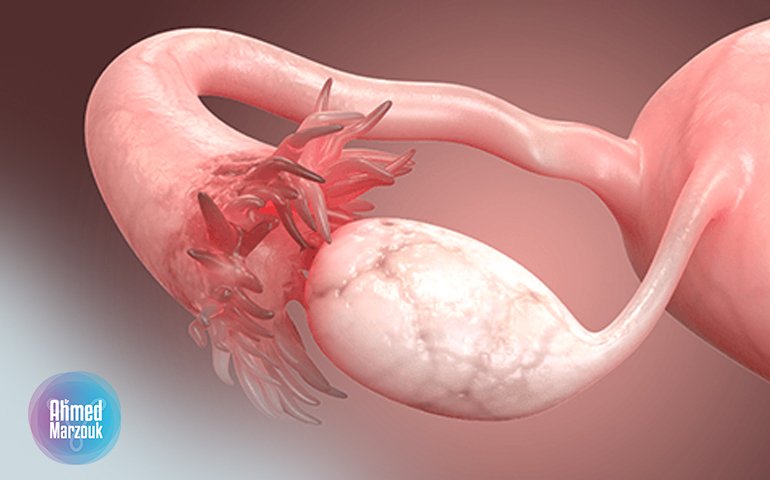
The fallopian tubes are the link that connects the ovary to the uterus, and they work to deliver the eggs produced by the ovary to the uterus each month so that they can be fertilized and thus form a fetus. The problem of blockage of these tubes is a major problem for some women because it hinders the occurrence of pregnancy. Learn with us about the symptoms of blocked fallopian tubes and how to treat them through my experience with a blocked fallopian tube with Dr. Ahmed Marzouk, obstetrics and gynecology consultant, in this article.
Symptoms that appear with blocked fallopian tubes:
Usually the signs of a blocked fallopian tube do not appear right at the onset of the blockage, and a woman with blocked fallopian tubes does not know she has this condition until she faces a problem conceiving. However, some mild symptoms may appear in some women that help in diagnosing blocked fallopian tubes, such as the following:
- Regular pain on one side of the abdomen.
- Severe pelvic pain associated with heavy menstrual bleeding.
Blocked fallopian tubes are confirmed through a dye X-ray (hysterosalpingography) of the uterus and tubes in the first half of the menstrual cycle. An X-ray may also be taken of them, as well as the use of a medical laparoscope to confirm the diagnosis if the previous steps are not successful.
Can pregnancy occur with blocked fallopian tubes? Or are the chances of pregnancy impossible?
There is no doubt that blocked fallopian tubes directly affect fertility, because, as we mentioned, the blockage of the tubes prevents the eggs from meeting the sperm needed to fertilize them. The answer to the question of pregnancy and blockage depends on the degree of the blockage itself, whether it is a complete blockage or a partial blockage. In the case of a complete blockage of the fallopian tubes, pregnancy is impossible because the egg is unable to meet the sperm at all. In the case of a partial blockage, the chance of pregnancy is possible, but a woman with a partial blockage of the fallopian tubes may develop an ectopic pregnancy because of the difficulty of the fertilized eggs moving to the uterus through that blocked tube. Blocked fallopian tubes are divided into the following: blockage of one fallopian tube, which does not affect fertility completely; rather, with it the chances of pregnancy remain possible, but with an increased risk of an ectopic pregnancy, since the unfertilized egg may move freely within the one tube so that it can be fertilized, and the fertilized egg may move within the other blocked tube and an ectopic pregnancy may occur through it.
Blockage of both fallopian tubes: in this case pregnancy is directly affected, and no fertilization occurs at all because the egg is unable to reach the sperm needed to fertilize it. In this case, it is recommended to resort to intracytoplasmic sperm injection (ICSI) to increase the chance of achieving pregnancy.
Causes of a blocked fallopian tube:
Blocked fallopian tubes have many causes, including the following:
- Having endometriosis.
- A previous ectopic pregnancy.
- Previous surgery in the lower abdomen.
- Having some uterine fibroids that must be removed with Dr. Ahmed Marzouk.
- Having a severe inflammation in the pelvic area.
- Contracting some sexually transmitted diseases such as chlamydia and gonorrhea.
Can blocked fallopian tubes be treated and pregnancy occur?
The treatment of blocked fallopian tubes and the possibility of pregnancy depend on the type of blockage itself and its location, as we mentioned. The best treatment for a blocked fallopian tube with Dr. Ahmed Marzouk includes the following:
Treating blocked fallopian tubes with medication:
This is in the case where the main cause of the blockage is a sexually transmitted infection such as chlamydia or gonorrhea, and it is treated by taking oral or intravenous antibiotics.
Treating blocked fallopian tubes with laparoscopy:
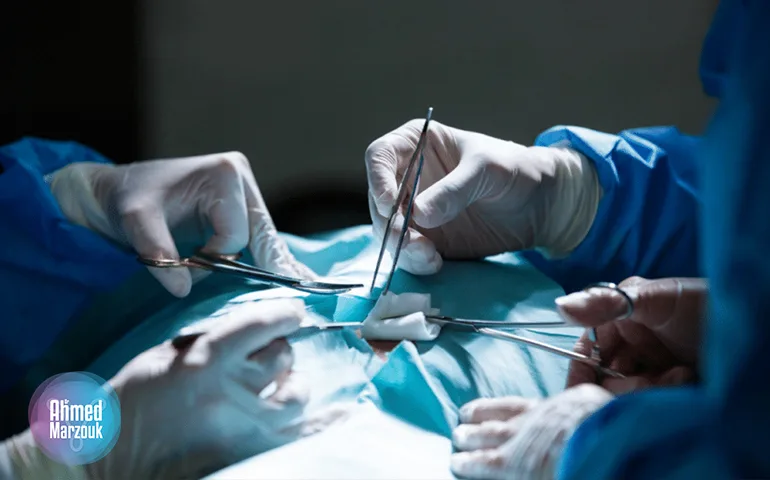
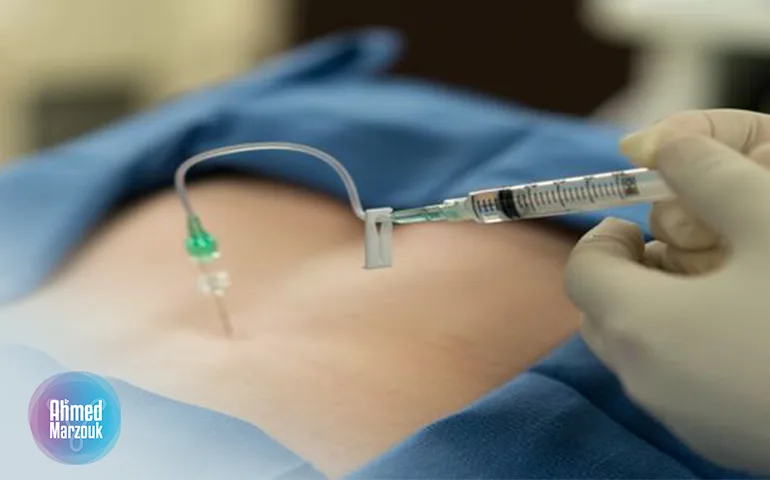
This step is resorted to if the cause of the blocked fallopian tubes includes the other causes we mentioned, apart from a sexually transmitted infection. Through this step, any tissue growths or scars causing the blockage of the tubes are removed, as well as draining any fluids collected in them, in order to prevent them from leaking into the uterus and thus causing an infection in it.
Treating blocked fallopian tubes with surgery:
This is an advanced step for treating blocked fallopian tubes, and it is done in the case of the failure of the laparoscopy step to treat the blockage, when the blockage is severe and the damaged part of the tissue in the fallopian tubes cannot be removed through laparoscopy.
Can I conceive after opening the fallopian tube?
Yes, you can become pregnant after opening the blockage of your fallopian tubes, as the chances of pregnancy increase after treating the blockage of the fallopian tubes, especially if the blockage is close to the uterus and has been treated.
What are the success rates of pregnancy after treating a blocked fallopian tube?
The success rates of pregnancy after treating a blocked fallopian tube depend on the severity of the blockage itself, whether it is due to a lot of tissue or just some simple tissue, as well as on the location of the blockage itself, as the success rates of pregnancy decrease with a blockage close to the ovary and increase with a blockage close to the uterus. In general, you can consult Dr. Ahmed Marzouk to be sure of your chances of a successful pregnancy after treating blocked fallopian tubes, as each case differs from another in its severity and in how it is treated with him.